Wake Forest Emergency Medical Services (WFEMS) recently partnered with school administration, community partners, and the Wake Forest University School of Medicine to enhance campus preparedness for victims of opioid overdose and for the possibility of an active shooter. Given the potential for opioid overdose on college campuses and the threat of active shooter emergencies, it is imperative that collegiate EMS agencies be proactive in campus preparedness efforts. Members of our campus community recognized a potential preparedness gap given the lack of community training in opioid overdose management and hemorrhage control. In this report we describe our advocacy efforts to have naloxone nasal spray and bleeding control kits co-located in our campus’ existing automatic external defibrillator (AED) stations as well as our efforts to provide community-based training programs.
Key elements of our campaign to help prevent opioid- and active shooter-associated morbidity and mortality were making naloxone nasal spray as well as bleeding control (“Stop-the-Bleed”) kits available throughout campus. Due to the number of readily available AED stations across Wake Forest University’s campus that community members are already familiar with and the cost-effectiveness of using already installed stations, WFEMS decided that placing both naloxone nasal spray and bleeding control kits inside the AED stations would be the best implementation strategy.
To accomplish this goal, WFEMS student leaders partnered with our physician medical director, campus legal counsel, and university administration. Our community partner, Forsyth County Behavioral Health Services, donated 40 4 mg intranasal naloxone kits. We identified 29 AED stations that were in a temperature-controlled environment with high campus visibility and foot traffic. We also campaigned to stock the campus AED stations with bleeding control kits. Wake Forest University School of Medicine’s Department of Surgery, Division of Acute Care, donated 35 bleeding control kits. Each kit contained: 1x C-A-T tourniquet, 1x 6 inch responder emergency trauma dressing, 2x wound packing gauze, 2x pair gloves, 1x trauma shears, 1x survival blanket, and 1x permanent marker. These kits were placed inside all of the temperature- controlled AED stations that also contained naloxone nasal spray as well as in 6 additional non-temperature-controlled AED stations. These efforts resulted in naloxone nasal spray and bleeding control kits being placed in 23 residential buildings and 6 high traffic academic and recreation buildings. Figure 1 describes the joint AED, naloxone nasal spray, and bleeding control kit stations on campus.
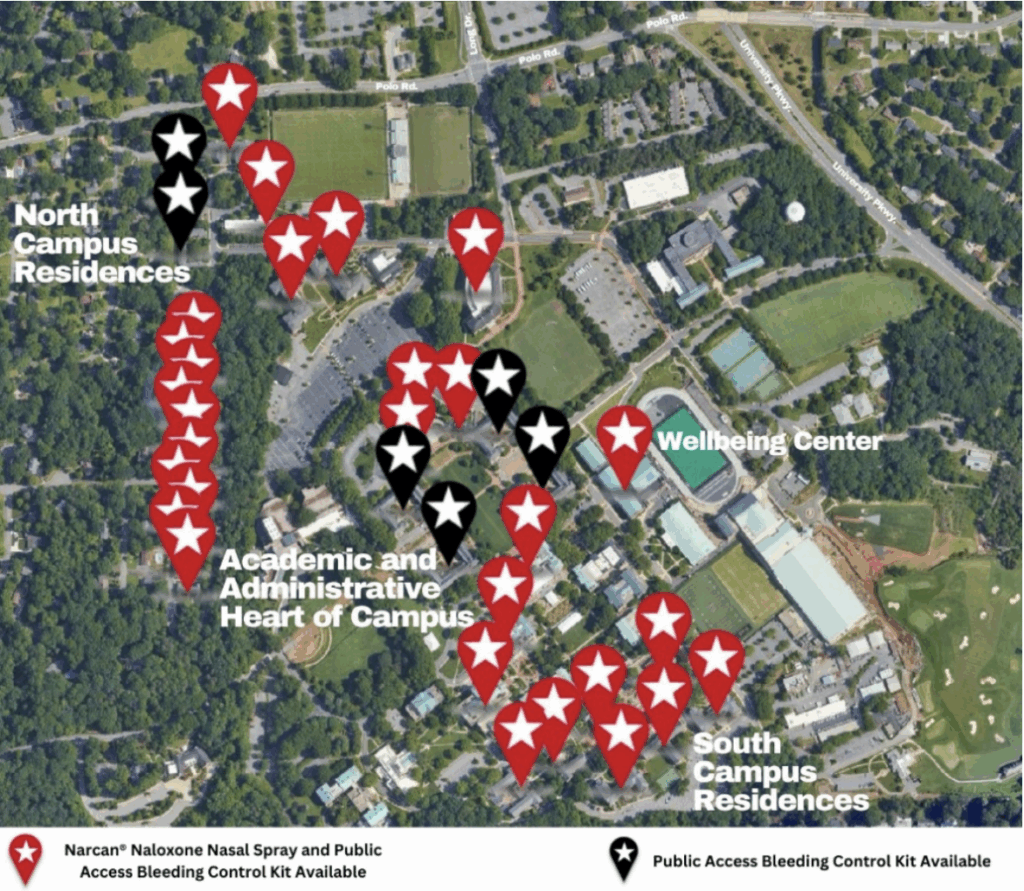
Figure 1. A map of Wake Forest’s campus marking all AED stations that have naloxone nasal spray and bleeding control kit housed in them.
To help ensure public familiarity and awareness of naloxone nasal spray and bleeding control kits being co-located with the AEDs, stickers were added to the outside of the AED stations. Figure 2 shows a typical AED station with a naloxone nasal spray and bleeding control kit setup.
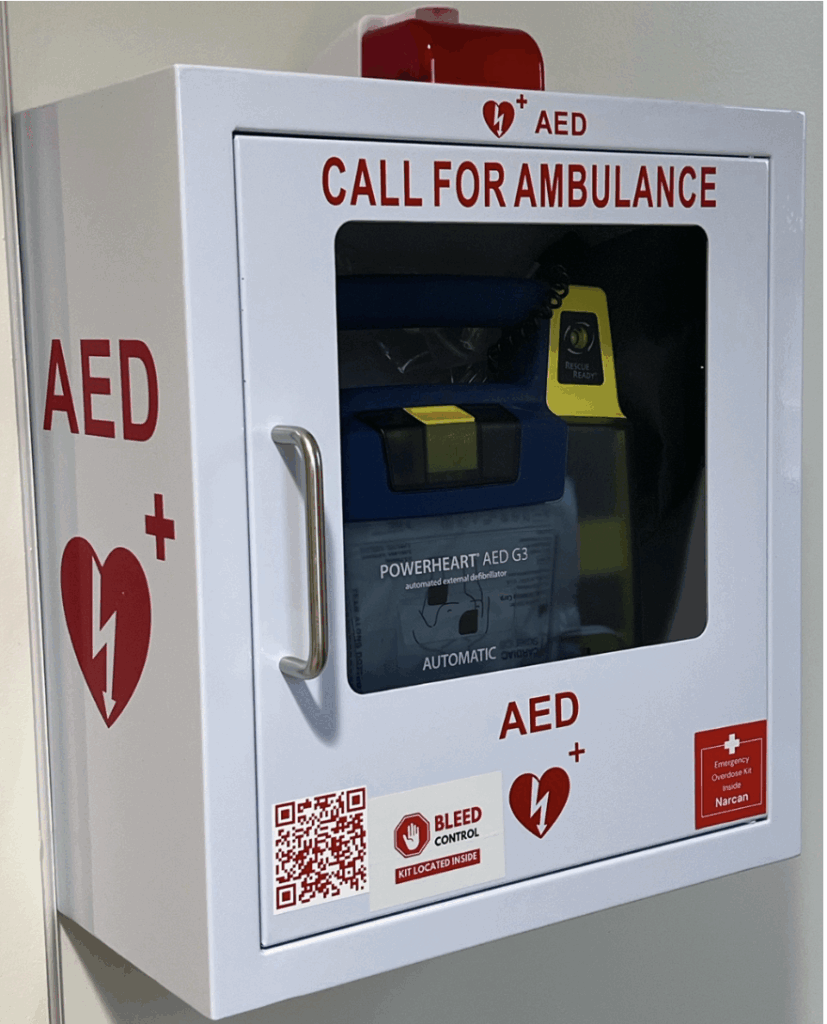
Figure 2. Labeling for the Wake Forest University AED stations with naloxone nasal spray and bleeding control kits.
To ensure that our campus community was familiar with naloxone nasal spray and the bleeding control kits, we hosted multiple training sessions open to all members of our community. In addition to public training, faculty from the Wake Forest University School of Medicine’s Department of Emergency Medicine led training events for overdose management and trauma care for all campus EMS members. Faculty from the Department of Surgery also assisted in these trainings by providing expertise in hemorrhage control. Lastly, our campus 911 dispatchers as well as university police and security officers are aware of these AED stations and have rapid access to maps detailing their locations and contents.
As of 5 months after implementation, 91.6% (44/48) of WFEMS members were trained and checked off by the WFEMS medical director for naloxone nasal spray and bleeding control kit use. Of those 44 members, 43.2% (19/44) have been approved by the medical director to teach community training programs on how to use the Narcan® Naloxone Nasal Spray and bleeding control kits. Those 19 individuals provided 4 official training sessions on campus. WFEMS trained roughly 60 Wake Forest students in those training sessions. These training sessions comprised of individuals 1) learning how to recognize a potential opioid overdose, 2) use naloxone nasal spray on the patient, 3) recognize what constitutes a major bleed, 4) and how to properly address life threatening hemorrhage. To date, no publicly available naloxone nasal spray or bleeding control kit has been used for clinical care at the Wake Forest University campus.
As next steps, WFEMS plans to 1) obtain additional naloxone nasal spray and bleeding control kits in order to stock additional AED stations throughout campus and 2) increase community awareness by conducting additional free, open-to-the-public training sessions on naloxone administration and hemorrhage control. A key barrier that we are working to overcome is the need for naloxone nasal spray to be temperature-controlled (55-77 °F). Many of our campus AED stations are outside and are unable to be temperature-controlled. As the naloxone nasal spray and bleeding control kits expire and are used, WFEMS will replace them with new kits obtained through donations from community partners or purchased with school funds. The use and expiration of said kits will be monitored by the university’s emergency management and preparedness team, which will update WFEMS accordingly. Through continued community engagement, public training opportunities, and regular dialogue with administration, we are working to mitigate a perception among community members that having naloxone nasal spray and bleeding control kits available may actually increase risk-taking behaviors and place our campus at increased threat of violent acts. It is our hope that our team’s efforts will empower other collegiate EMS agencies to engage in similar community preparedness and prevention efforts.
Acknowledgments
WFEMS would like to acknowledge the support of the Wake Forest University School of Medicine’s Department of Surgery, Division of Acute Care Surgery, and Forsyth County Behavioral Health Services. We would also like to acknowledge Dr. Warrenetta Mann for her administrative support at Wake Forest University.