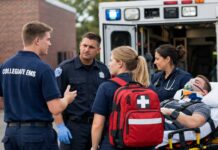


Since 2000, the second week in November has been dedicated to honoring the contributions of over 8,400 EMS providers across the nation.¹ ² Officially known as National Collegiate EMS Week, this week, modeled from National EMS Week in May, was a celebration known only amongst collegiate EMS agencies and the founding professional organization known as the National Collegiate Emergency Medical Services Foundation (NCEMSF).
This year, the celebration has received interstate and governmental recognition, marking a significant milestone for hard-working collegiate EMS providers of past and present. On November 05, 2025 in Washington D.C., the Interstate Commission for EMS Personnel Practice, commonly known as the EMS Compact Commission, adopted Resolution 2025-05, formally recognizing November 10-16, 2025 as National Collegiate EMS Week.
Every year, the week-long dedication kicks off with National Collegiate CPR Day. The 2025 CPR Day Letter written by NCEMSF President, Dr. George J. Koenig, Jr., DO, emphasized the importance of starting the week off with National Collegiate CPR Day. Dr. Koenig describes this observance as an execution day for collegiate EMS clinicians to train and educate as many fellow college students, faculty, staff, and visitors about the life-saving value of CPR as possible.³
The remainder of National Collegiate EMS Week consists of a collegiate EMS agency-varied schedule ranging from public health educational events to naloxone and bleeding control trainings, as well as open-house events for the campus community to engage with collegiate EMS professionals, tour their stations, and learn about their day-to-day lives.
The newly adopted resolution honors the dedication and impact of student EMS providers serving through their campus-based EMS programs across North America. The resolution expresses that the “Commission commends the thousands of collegiate EMS clinicians and programs across the nation whose service strengthens the EMS profession, enhances community safety, and fosters the next generation of EMS leaders.”⁴ By acknowledging the collegiate EMS clinician’s role in public safety, leadership development and emergency care, the Commission’s decision validates significance in national recognition for collegiate EMS agencies. Dr. Scott Savett, Ph.D, Vice President and Chief Technology Officer of NCEMSF commented on the resolution via email on November 06, 2025, emphasizing that “NCEMSF is proud to celebrate our collegiate EMS providers who adeptly balance their academic studies with service to their campus community.”
The United States EMS Compact Commission is the lead governmental authority responsible for EMS licensure and promotes professionalism, EMS clinician practice accessibility and mobility. This body is responsible for the United States EMS Compact, which is established state law in 25 states across the country, and allows for greater than 400,000 EMS clinicians to provide life-saving care in partnering states.⁵ “During school breaks, many [collegiate EMS clinicians] return to their home communities, where they may also serve as EMS providers. The EMS Compact enables providers to deliver EMS care across different jurisdictions without incurring additional administrative burdens, making it a win-win,” says Dr. Savett.
The EMS Compact Commission’s commendation of National Collegiate EMS Week affirms the essential role collegiate EMS providers play in supporting public safety. This national-level policy is a defining step towards acknowledging the value of investing in student responders whose training, leadership and service form the backbone of many communities’ pre-hospital care.
References
National Collegiate Emergency Medical Services Foundation. National Collegiate EMS Foundation: Everything you need to know and more…. NCEMSF. Published online. Accessed November 13, 2025. https://www.ncemsf.org/ems-week-articles/825-national-collegiate-ems-foundation-everything-you-need-to-know-and-more
National Collegiate Emergency Medical Services Foundation. How important is campus EMS? Here are some statistics to share…. NCEMSF. Published online. Accessed November 13, 2025. https://www.ncemsf.org/ems-week-articles/826-how-important-is-campus-ems-here-are-some-statistics-to-share
National Collegiate Emergency Medical Services Foundation. National Collegiate CPR Day Letter 2025. Published 2025. Accessed November 13, 2025. https://www.ncemsf.org/resources/downloads/ems-week-documents/899-cpr-day-letter-2025/file
Interstate Commission for EMS Personnel Practice. Resolution 2025-05: Recognizing November 10–16, 2025 as National Collegiate Emergency Medical Services Week. Adopted November 5, 2025. Available at: https://www.emscompact.gov
Interstate Commission for EMS Personnel Practice. EMS Compact. Accessed November 13, 2025. https://www.emscompact.gov/
Author & Article Information
Grace Lu is currently a student in the Bachelor of Health Sciences (Honours) Program at McMaster University. Lu holds the role of Assistant Editor for The Journal of Collegiate Emergency Medical Services. Adhitya Balaji, BS, NREMT is a third-year medical student at the Indiana University School of Medicine and serves as the Co-Director of Journal Operations for The Journal of Collegiate Emergency Medical Services. Marissa Canty, MBA, NRAEMT is a third-year medical student at the University of New England College of Osteopathic Medicine. Canty serves as the Managing Editor of The Journal of Collegiate Emergency Medical Services.
Author Affiliations: From McMaster University – Hamilton, Ontario, Canada (G.L.). From Indiana University School of Medicine – Indianapolis, IN (A.B.). From University of New England College of Osteopathic Medicine – Portland, ME (M.C.).
Address for Correspondence: Grace Lu | jcems@jcems.org
Conflicts of Interest/Funding Sources: By the JCEMS Submission Declaration Form, all authors are required to disclose all potential conflicts of interest and funding sources. All authors serve as uncompensated members of JCEMS. All authors declared that they have no other conflicts of interest. All authors declared that they did not receive funding to conduct the research and/or writing associated with this work.
Authorship Criteria: By the JCEMS Submission Declaration Form, all authors are required to attest to meeting the four ICMJE.org authorship criteria: (1) Substantial contributions to the conception or design of the work; or the acquisition, analysis, or interpretation of data for the work; AND (2) Drafting the work or revising it critically for important intellectual content; AND (3) Final approval of the version to be published; AND (4) Agreement to be accountable for all aspects of the work in ensuring that questions related to the accuracy or integrity of any part of the work are appropriately investigated and resolved.
Submission History: Submitted November 13, 2025; accepted for publication November 14, 2025
Published Online: November 15, 2025
Published in Print: February 20, 2026
Reviewer Information: In accordance with JCEMS editorial policy, in News & Commentary manuscripts are reviewed by the JCEMS Editorial Board. JCEMS thanks the Editorial Board members who contributed to the review of this work.
Copyright: © 2025 Lu, Balaji & Canty. This is an open-access article distributed under the terms of the Creative Commons Attribution 4.0 International (CC BY 4.0) License, which permits unrestricted use, distribution, and reproduction in any medium, provided the original author and source are credited. The full license is available at: https://creativecommons.org/licenses/by/4.0/
Electronic Link: https://doi.org/10.30542/JCEMS.2026.08.01.01