
2026 • 8(1) • DOI: 10.30542/JCEMS.2026.08.01.15
Poster Presentation Abstract
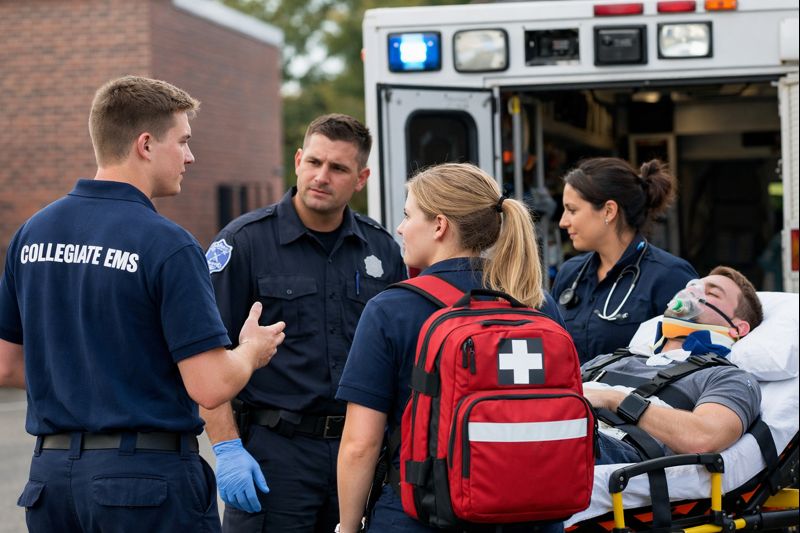
The quality and consistency of patient handoff reports are critical for effective communication between basic life support (BLS) collegiate emergency medical services (EMS) and advanced life support (ALS) units. Miscommunication during handoffs risks omitting vital information, potentially delaying treatment as non-transport units add another layer to patient care. This study evaluates the content and quality of oral patient handoff reports by Gator Emergency Response Unit (GEMRU) leads, licensed EMTs serving as touchpoints between the Unit and responding ALS teams. Present on every shift, these leads are cleared by supervisors for mastery in assessments, treatments, and operations within GEMRU protocols.
A survey of EMS professionals, including emergency medicine physicians and paramedics, identified essential components for patient care reports: patient demographics, chief complaint, signs and symptoms, vitals, interventions, response to treatment, and pertinent medical history. Trauma and medical scenarios were developed to test leads’ ability to prioritize critical details and adhere to medical protocols. The recorded handoff reports were analyzed for inclusion of these components and consistency.
Despite professional consensus on critical components, GEMRU leads frequently omitted essential details, including demographics, vitals, and chief complaints, while averaging quick delivery times of 27 seconds. No significant similarities were observed in report delivery based on call type (medical or trauma) and leads often included extraneous information not deemed important by higher levels of care. These findings highlight gaps in training and the absence of a standardized approach to handoff communication.
To address these gaps, a structured mental training checklist tailored to call type is proposed. Such a checklist would serve as a cognitive framework for leads, guiding them to deliver a structured and concise report to ALS for medical and trauma calls. Implementing this training protocol could significantly improve the quality and consistency of collegiate EMS handoffs, enhancing ALS readiness and improving patient outcomes.
Download Poster
Author and Article Information
Address for Correspondence: Quinn Shepard | Email: shepardquinn@ufl.edu
Conflicts of Interest/Funding Sources: By the JCEMS Submission Declaration Form, all authors are required to disclose all potential conflicts of interest and funding sources. The authors declared that they have no conflicts of interest. The authors declared that they did not receive funding to conduct the program or research associated with this work.
Ethical Compliance: The authors attest that the research associated with this abstract was conducted in accordance with the JCEMS Ethics Guidelines.
Submission History: Received December 27, 2024; accepted for presentation and publication February 11, 2025.
Poster Presentation: This abstract was presented as a poster at the Academic Poster Session of the 33rd Annual Conference of the National Collegiate Emergency Medical Services Foundation; February 23-25, 2025; Pittsburgh, PA, USA. The authors received the First Place Award in the Poster Presentation Competition.
Published Online: January 23, 2026
Published in Print: February 23, 2026 (Volume 8: Issue 1)
Reviewer Information: In accordance with JCEMS editorial policy, poster presentation abstracts undergo double-blind peer-review by at least two reviewers (JCEMS Editorial Board members and/or independent reviewers) prior to acceptance for presentation and publication. JCEMS thanks the anonymous reviewers who contributed to the review of this work.
Copyright: © 2025 Quinn, Sadorf, & Abdelghany. This is an open access article distributed under the terms of the Creative Commons Attribution 4.0 International (CC BY 4.0) License, which permits unrestricted use, distribution, and reproduction in any medium, provided the original author and source are credited. The full license is available at: https://creativecommons.org/licenses/by/4.0/
Electronic Link: https://doi.org/10.30542/JCEMS.2026.08.01.15