
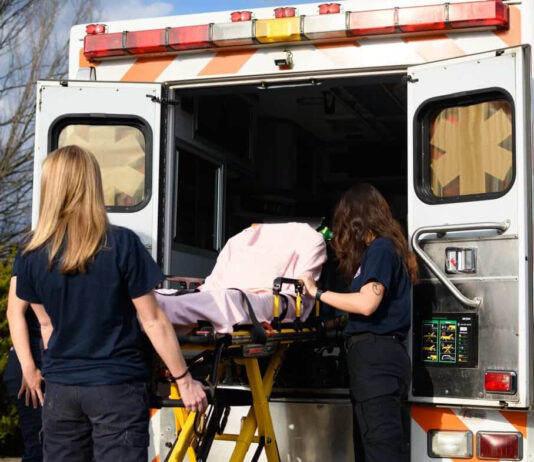
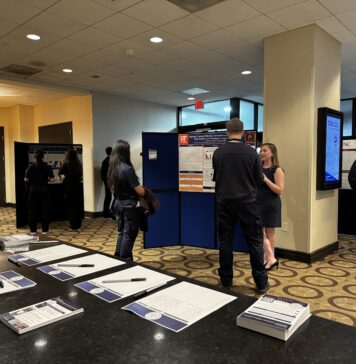
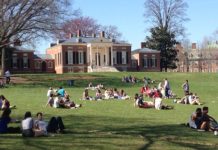
Johns Hopkins Emergency Response Organization (HERO) lays the groundwork for inter-facility transport
Under the leadership of Christopher Wend (former Captain) and Leela Herbst (current Captain), HERO prepares for inter-facility transports.
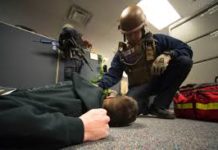
Embry Riddle Aeronautical University Emergency Response Team hosts a multi-agency active shooter drill based...
Connor Black, the Assistant Chief of the Emergency Response Team (ERT) at Embry-Riddle Aeronautical University, sat down with the JCEMS news...
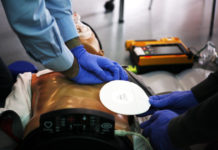
Illinois Institute of Technology creates on-campus EMS organization with initial focus on community CPR/AED...
Current student Alexandra Montgomery leads the charge to develop a new campus EMS organization.
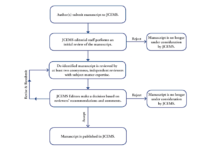
Peer Review of Collegiate EMS Scholarly Literature
JCEMS employs a double-blind peer review process to filter manuscripts for publication. We believe that the process minimizes bias, promotes fairness, encourages appropriate criticism, and strengthens the quality of submitted manuscripts.
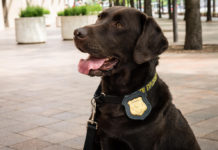
Non-Veterinary Emergency Care of Law Enforcement Canines at Mass Gathering Events
This case report describes the development, implementation, and evaluation of a pilot training course for collegiate EMS providers on the treatment of law enforcement canines.
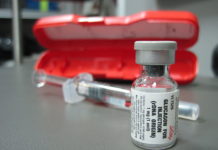
Prehospital Management of Hypoglycemic Emergencies
This review discusses the pathophysiology and presentation of hypoglycemic emergencies, as well as assessment and treatment options across different scopes of practice for emergency medical services providers.
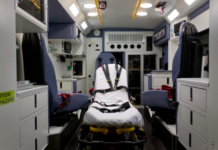
Designing Safety into Ambulances
Massachusetts Institute of Technology EMS designed an innovative new ambulance, incorporating best practices and current evidence to enhance provider safety.
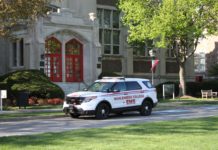
Utilizing a Scramble Crew Approach to Achieve 24-Hour Coverage
In 2016, Muhlenberg College EMS reinstituted daytime response, incorporating Active 911, a digital messaging system, and an all-call, scramble crew model. Since the new response plan began in March of 2016, Muhlenberg College EMS has responded to 47 calls that may have otherwise been ignored, at a response time shorter than that of normal duty crew responses.
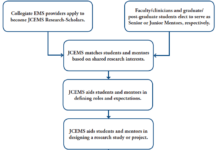
The JCEMS Research Mentorship Program
JCEMS developed a Research Mentorship Program to build research capacity in the collegiate EMS community.
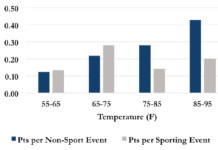
EMS Resource Utilization at College Campus Mass Gathering Events
This study aimed to examine EMS utilization during mass gathering events at an urban university with a collegiate-based EMS agency. Findings suggest that college event planners can potentially utilize event and weather features to predict EMS resource utilization.